

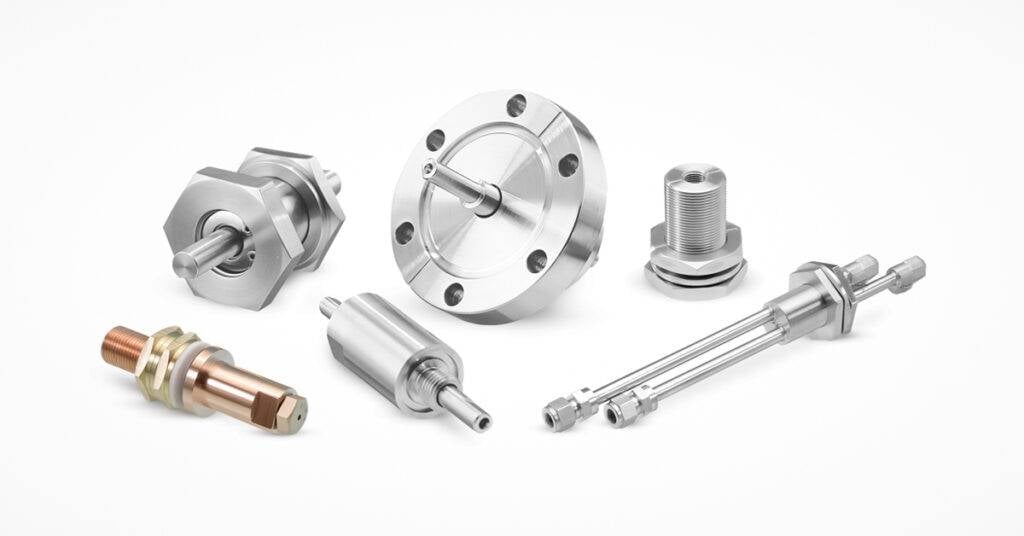
Electrical feedthroughs move power, signal, and temperature data across the wall of a vacuum chamber without breaking vacuum integrity. Selecting the right one comes down to four considerations: What are you transferring (i.e., power, a shielded signal, multiple conductors, or temperature data)? What voltage and current does it need to carry? How many pins or channels do you need in one port? And what flange does your chamber use?
This guide breaks down each ANCORP feedthrough type, its specifications, and where it fits in a vacuum system to ensure your feedthrough selection is optimized for your application.
Table of Contents
What Is a Vacuum Electrical Feedthrough?
A vacuum electrical feedthrough is a hermetically sealed connector that passes electrical conductors through a chamber wall while maintaining the chamber’s vacuum level on one side and atmosphere (or another vacuum stage) on the other. Conductors are sealed into the feedthrough body with a ceramic or PTFE insulator, and the whole assembly mounts to the chamber through a standard vacuum flange (typically ConFlat (CF), KF/QF, or ISO-K) or through a threaded baseplate port.
The right feedthrough depends on what is crossing the boundary. Raw power needs conductor mass and insulation rated for current and voltage. Sensitive signals need shielding against electromagnetic interference. Dense instrumentation needs many conductors in a small footprint. Temperature data needs matched thermocouple materials to preserve measurement accuracy. ANCORP’s electrical feedthrough line is organized around exactly these use cases.
For an overview of ANCORP’s full feedthrough range including fluid, rotary motion, and transition feedthroughs, see the Vacuum Feedthrough Selection Guide.
Seven Types of Electrical Feedthroughs
| Feedthrough Type | Best For | Voltage Range | Current Range | Flange Options |
|---|---|---|---|---|
|
Sputtering, deposition, substrate heating |
Under 50V |
400–1000 A |
1″ baseplate |
|
|
Deposition sources, process equipment |
8–30kV |
Up to 800A |
CF, KF16-KF50 |
|
|
Shielded instrumentation, diagnostics |
500V-5kV |
3-5A |
CF 1.33″/2.75″, KF16/KF40 |
|
|
Dense multi-signal wiring |
Up to 500V |
5A/pin |
CF, KF40/KF50, ISO-K |
|
|
Power/signal pass-through, many channels |
700V-1kV |
3-10A/pin |
KF, KF16/KF40 |
|
|
In-chamber temperature monitoring |
N/A (signal) |
N/A (signal) |
CF 1.33″/2.75″, KF16 |
|
|
Electrical/thermal isolation |
5-60kV isolation |
N/A |
CF 1.33″/2.75″, KF16/KF40 |
|
|
Field service and maintenance |
|
|
|
1. High-Current Power Feedthroughs (400 Amp and 1000 Amp)
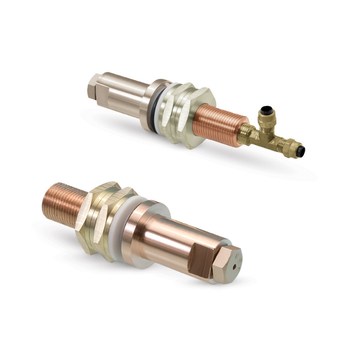
ANCORP’s 400-amp and 1000-amp water-cooled feedthroughs are ANCORP’s original high-power electrical feedthrough line, built for low-voltage, high-current transfer — typically under 50 volts with current in the hundreds to low-thousands of amps. That pairing makes them fit for deposition sources, sputtering targets, plasma generation, and substrate heating in semiconductor manufacturing, thin film deposition, and research systems.
Both feedthroughs mount to a standard 1″ diameter baseplate hole and use one-piece construction to eliminate joint leak paths. Construction is oxygen-free copper (OFC) and brass with PTFE insulators; the 1000-amp version adds a water line connector sized for ¼” poly flow tubing to manage heat at high amperage.
Quick reference
- Voltage: Up to 50 V (low voltage)
- Current: 400 A or 1000 A (water-cooled)
- Materials: Oxygen-free copper (OFC), brass, PTFE insulator
- Connection: 1″ baseplate
2. Power Feedthroughs (High Voltage, High Current)
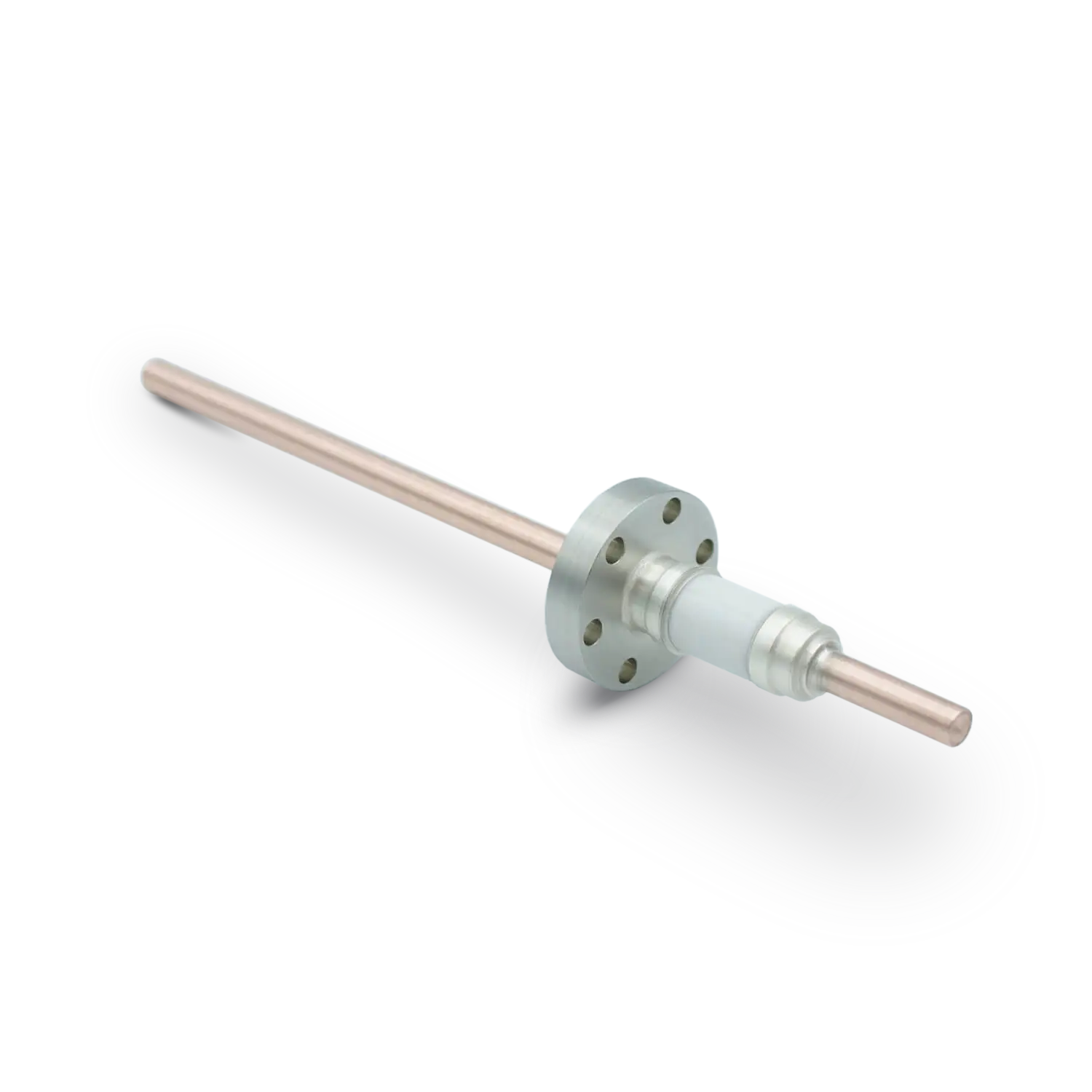
For applications that need more voltage than the baseplate line offers, ANCORP’s power feedthroughs deliver high-current, high-voltage power through copper conductors with alumina insulation, bakeable to 450 °C. The line spans 8 kV to 30 kV and up to 800 A, across 1-, 2-, and 4-pin configurations on ConFlat and KF flanges from KF16 to KF50.
This is the family to specify for deposition system power delivery, ion source biasing, and other process equipment where standard low-voltage feedthroughs don’t meet voltage requirements and baseplate mounting isn’t required.
Quick reference
- Voltage: 8–30 kV
- Current: Up to 800 A
- Pin configurations: 1, 2, or 4 pins
- Flange: ConFlat (1.33″, 2.75″), KF16–KF50
- Bakeout: 450 °C
3. Coaxial Feedthroughs
Coaxial feedthroughs carry shielded, low-current signals across the vacuum boundary, making themit the right choice when a signal needs to avoid electromagnetic interference. ANCORP’s line covers BNC and SHV-5 bayonet connectors in both grounded and floating-shield configurations, rated from 500 V to 5 kV, on 1.33″ and 2.75″ ConFlat or KF16/KF40 flanges, in 1-, 2-, and 4-pin builds.
Coaxial feedthroughs are the standard choice for instrumentation, diagnostics, and signal transmission in research chambers, semiconductor process tools, and vacuum coating systems where measurement accuracy depends on shielding.
Quick reference
- Connectors: BNC (500 V–2.5 kV), SHV-5 (5 kV)
- Shield type: Grounded or floating
- Pin count: 1, 2, or 4
- Flange: ConFlat (1.33″, 2.75″), KF16/KF40
- Vacuum range: Up to 1×10⁻¹⁰ Torr (CF)
4. D-Sub Feedthroughs
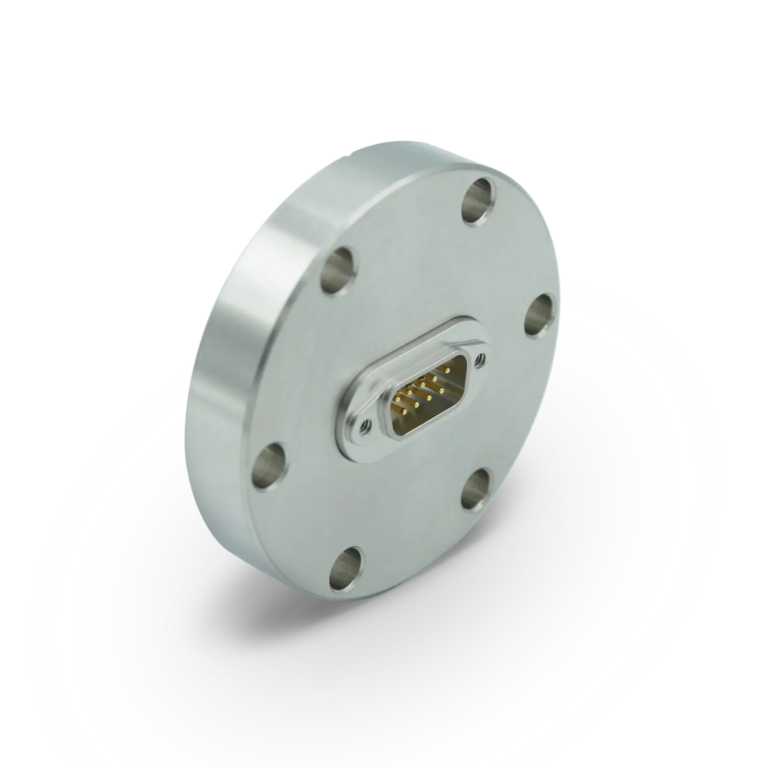
D-Sub feedthroughs pack multiple signal and instrumentation conductors into a compact, high-density connector. These are especially useful when you need dense wiring without stacking multiple single-pin feedthroughs on the same flange.
ANCORP’s MIL-C-24308 line offers 9-, 15-, and 25-contact configurations rated to 500 V and 5 A per pin, on ConFlat, KF40, KF50, and ISO-K flanges, with optional UHV vacuum-side connectors.
Bakeable to 250 °C, D-Sub feedthroughs suit dense wiring runs in research instrumentation, semiconductor tooling, and vacuum coating control systems.
Quick reference
- Contacts: 9, 15, or 25 (MIL-C-24308)
- Rating: 500 V, 5 A/pin
- Flange: ConFlat, KF40, KF50, ISO-K (LF63)
- Bakeout: 250 °C
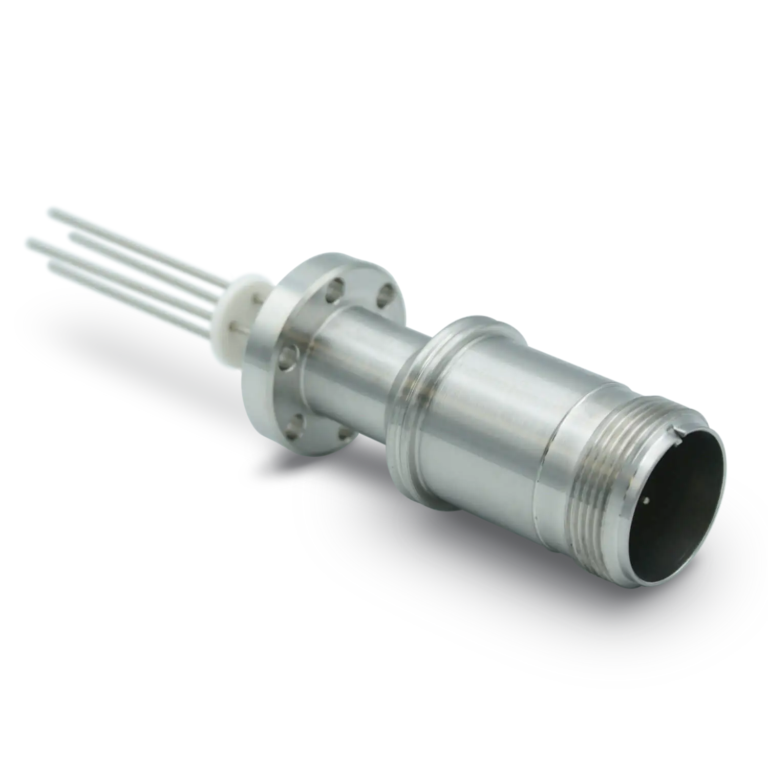
5. Multipin Feedthroughs
Multipin feedthroughs route many independent conductors through a single vacuum port, saving flange real estate on systems with dense wiring needs.
ANCORP offers two connector families: threaded MIL-C-5015 circular connectors (4–10 pins, 700 V, 10 A per pin) for power and general signal runs, and compact, high-density MIL-C-26482 connectors (up to 32 pins, 1 kV, 3 A per pin) for instrumentation-heavy applications — available in single- or double-ended builds on ConFlat and KF flanges.
Quick reference
- MIL-C-5015: 4–10 pins, 700 V, 10 A/pin
- MIL-C-26482: Up to 32 pins, 1 kV, 3 A/pin
- Configuration: Single- or double-ended
- Flange: ConFlat (1.33″, 2.75″), KF16/KF40
6. Thermocouple Feedthroughs
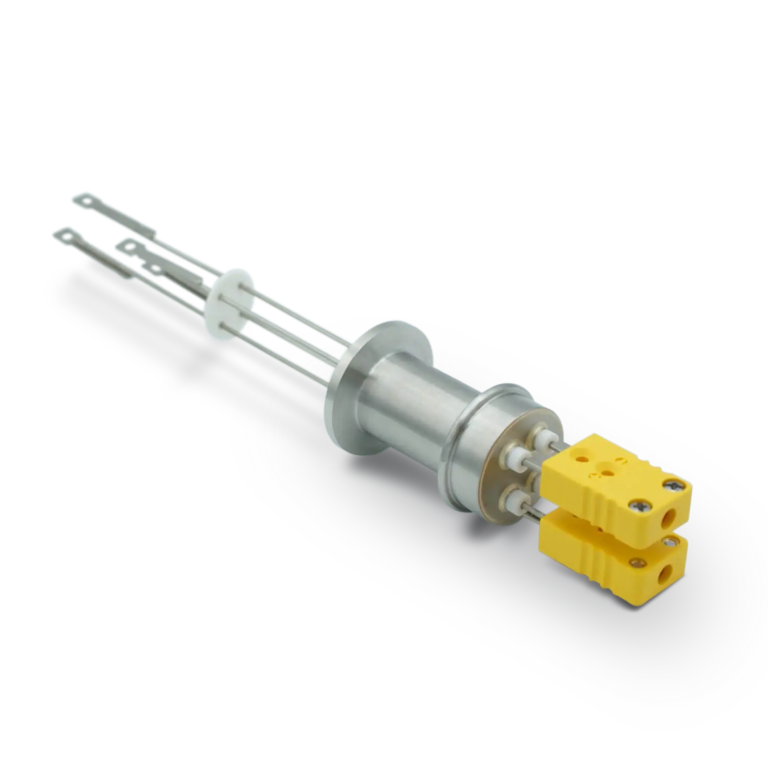
Thermocouple feedthroughs are purpose-built for accurate in-vacuum temperature measurement rather than power delivery or general-purpose signal transfer. ANCORP’s Type K line carries one or two matched thermocouple pairs through miniature connectors on both the air and vacuum sides, preserving measurement accuracy across the vacuum boundary.
Type K thermocouple feedthroughs are classified by their unique metal pairing of Chromel (nickel-chromium) and Alumel (nickel-aluminum) alloys. Available on 1.33″/2.75″ ConFlat and KF16 flanges and bakeable to 450 °C, they’re built for temperature monitoring in research, semiconductor, and vacuum coating applications.
Quick reference
- Thermocouple type: K
- Pairs: 1 or 2
- Connector: Miniature TC connector, double-ended
- Flange: ConFlat (1.33″, 2.75″), KF16
- Bakeout: 450 °C
7. Ceramic Break Feedthroughs
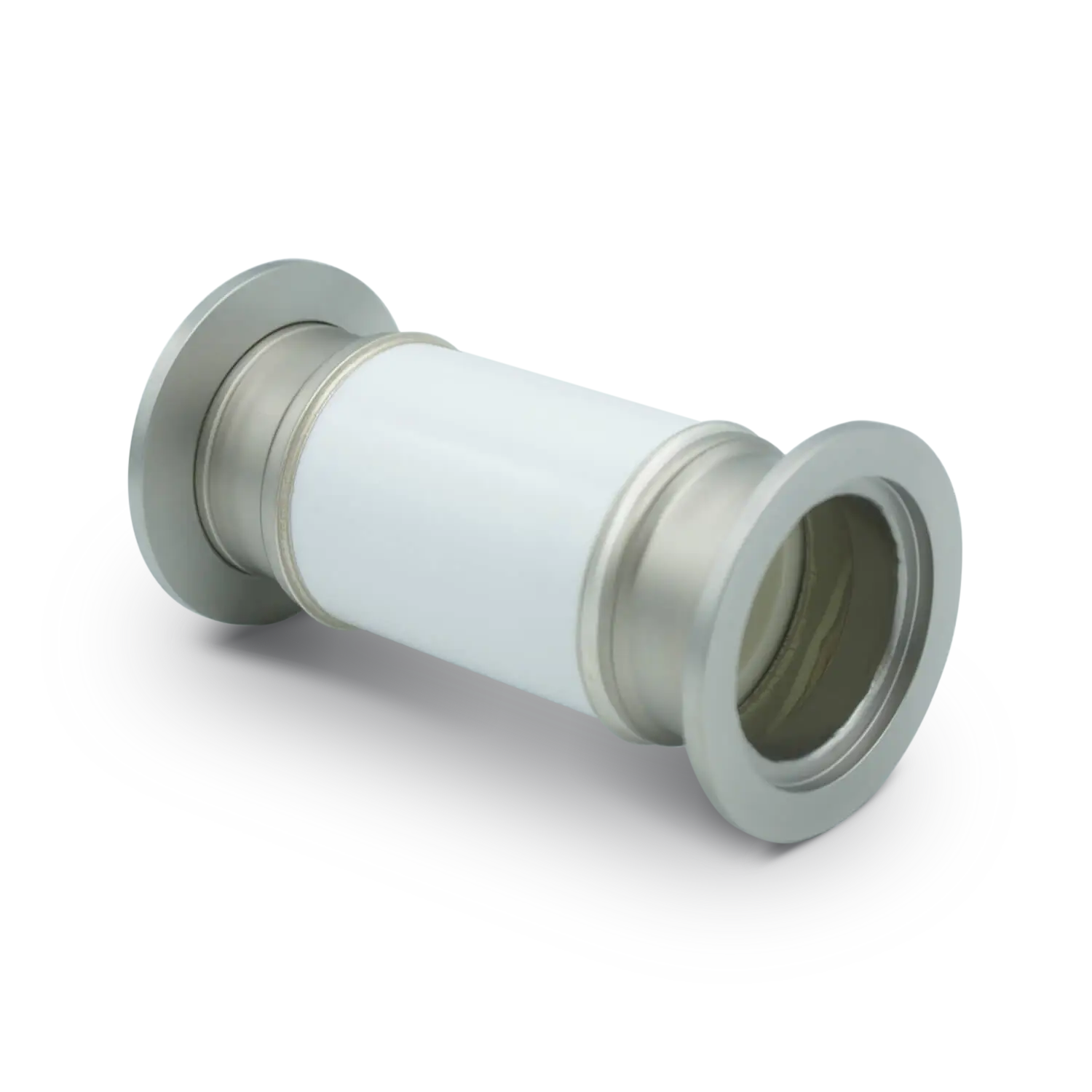
Ceramic break feedthroughs, also called ceramic isolators, do not necessarily function as a bridge as most feedthroughs do; they serve as a deliberate break in one. They provide electrical and thermal isolation between two vacuum components while still sealing the vacuum boundary.
ANCORP’s alumina-insulated, ceramic-to-metal line offers 5 kV to 60 kV isolation with 0.63″ and 1.37″ tube adapters, on rotatable ConFlat (1.33″, 2.75″) and KF16/KF40 flanges. With a helium leak rate below 1×10⁻⁹ atm·cc/sec and bakeout to 450 °C, they’re built for high-voltage isolation in research and vacuum coating systems.
Quick reference
- Isolation voltage: 5–60 kV
- Adapter diameter: 0.63″ or 1.37″
- Flange: Rotatable ConFlat (1.33″, 2.75″), KF16/KF40
- Leak rate: <1×10⁻⁹ atm·cc/sec
- Bakeout: 450 °C
Electrical Feedthrough Replacement Parts
Beyond new feedthroughs, ANCORP stocks replacement parts for electrical feedthroughs already in service, so a worn seal or connector doesn’t mean replacing the whole assembly.
Contact ANCORP with your part or reference number to confirm compatible replacement components.
How to Choose the Right Electrical Feedthrough
Work through these questions in order:
- What’s crossing the boundary — power, signal, or temperature data? Power points you to the 400/1000-amp or power feedthrough lines; shielded signal points to coaxial; temperature data points to thermocouple feedthroughs.
- Does the signal need shielding? If interference matters, coaxial feedthroughs are purpose-built for it. If not, D-Sub or multipin may be more space-efficient.
- How many conductors do you need in one port? A single power line may only need a 1-pin feedthrough; dense instrumentation runs are better served by 25-pin D-Sub or 32-pin multipin connectors.
- What voltage and current does the application demand? Cross-check your requirement against the quick-reference specs above For power delivery, verify that the feedthrough’s voltage and current ratings meet the application requirements. If electrical isolation between vacuum components is required, a ceramic break may also be needed.
- What flange does your chamber use? Confirm ConFlat, KF/QF, ISO-K, or baseplate compatibility before ordering; most ANCORP electrical feedthroughs are available across multiple flange types.
If your application doesn’t fit neatly into one of these families — for example, a nonstandard voltage, pin count, or bakeout requirement — contact ANCORP or use live chat with your specifications.
Electrical Feedthrough FAQs
Coaxial feedthroughs are single- or low-pin-count connectors built around shielded BNC or SHV-5 interfaces to protect a signal from electrostatic interference. Multipin feedthroughs prioritize conductor density — routing up to 32 independent, unshielded pins through one port — and are better suited to power distribution or instrumentation runs that don’t require shielding.
Most of ANCORP’s electrical feedthrough lines are bakeable, though the rated temperature varies by connector material and family. D-Sub feedthroughs are rated to 250 °C, while power, thermocouple, and ceramic break feedthroughs are rated to 450 °C. Check the specific product page for your configuration before baking as this is further dependent on how your feedthrough connects to the port.
Depending on the family, ANCORP electrical feedthroughs are available on ConFlat (CF) flanges in 1.33″, 2.75″, and 4.50″ sizes; KF/QF flanges from KF16 to KF50; ISO-K (LF63); and 1″ baseplate mounts for the high-current line.
Only if you need to electrically or thermally isolate two vacuum components from each other — a ceramic break serves a different function than a standard power feedthrough. It’s common to use both in the same system: a power feedthrough to deliver current, and a ceramic break to isolate a biased chamber section from grounded hardware.
ConFlat-flanged electrical feedthroughs are typically rated for UHV performance (1×10⁻¹⁰ Torr), while KF/QF and baseplate-mounted versions are rated for HV service (1×10⁻⁸ Torr).
Explore More Feedthroughs
Electrical feedthroughs are one of four feedthrough categories ANCORP manufactures. Depending on what your system needs to transfer across the vacuum boundary, also see:
- Fluid and Gas Feedthroughs — cryogenic and non-cryogenic fluid transfer
- Rotary Motion Feedthroughs — elastomer- and ferro-sealed rotational motion transfer
- Transition Feedthroughs — baseplate-to-flange and baseplate-to-fitting adapters
Ready to spec your system? Shop the full Electrical Feedthroughs category by selecting a section below or request a quote and an ANCORP engineer will help you match a feedthrough to your application.


Vacuum Feedthrough Selection Guide
Choosing the Right Feedthrough Connection for Your Needs In vacuum systems, selecting...
Read More